Sunday, 24 June 2012

The Dø @ The Garage, London 12/4/12

The Do - Live At The Garage, London
The old adage that London gig audiences are hard to please has one very simple solution. Simply replace all the Londoners in the audience with French people. It's a tactic that gives tonight's gig, by Franco-Finnish hybrid The Dø (pronounced the same as 'dough'), an atmosphere akin to a homecoming show.
The boy/girl two-piece enjoy a hero’s welcome as they take to the stage, which is adorned with the kind of percussion instruments you'd associate more with an African tribal group, less with a quirky indie pop band from the continent.
But then again, The Dø are not your average quirky indie pop band from the continent, at least not anymore. Their debut went to number one in the French album chart and last year's follow up 'Both Ways Open Jaws' was an improved, more refined take on their scattershot sound.
They're even more of an uncategorisable prospect live, jumping from style to style as freely as if they were changing their socks. The placid musicians that open the set – with a sweeping song that showcases lead singer Olivia Bouyssou Merilahti's icy, childlike vocals - is virtually unrecognisable from the band a few songs down the line, who revel in pounding artificial drum beats and sustained guitar feedback.
On record, The Dø roughly occupy a space in the middle of a graph that has fellow Europeans Air and The Knife at either axis. But live, flanked by two other musicians, one in charge of the drum machine and the other a pony-tailed electric guitarist, the industrial rock grind of The Kills begins to creep in, albeit in a more polished, shiny form.
'The Bridge Is Broken', dispatched early on, has instant appeal. It's a catchy, fiery tale of betrayal that takes in a backwards guitar riff and electronic meanderings, as the lead singer wails "Boy you got nerve/it's all your fault/this stitch is open".
But The Dø are a hard band to predict. 'Dust It Off', a song that initially has a soft, hypnotic, swirling piano melody at its core, unravels at its climax, drum machine in overdrive and guitars entering cardiac arrest.
However, this chameleon-like approach to songwriting means not everything comes off. Sometimes, without a clear plan in mind, their songs are mere indulgent ideas, performed with the kitchen sink but without proper execution.
But you need only wait a bit untill something eventually connects. The topsy turvy groove and sweet melody of 'Gonna Be Sick' for example, the bhangra beat exuberance running through 'Slippery Slope', or the layered pop hooks on 'Smash Them All Night'.
Often, it's the vocals of frontwoman Olivia that hit the spot, with a Nordic twang similar to Bjork's, mixed with the same crystal clear delivery. Her voice is a recurrent centrepiece in the jigsaw puzzle that is The Dø's sound; not exactly edgy, but arrestingly unconventional all the same.

Published on Clashmusic.com
Photo by Helen F Kennedy

Weird Dreams @ The Others, London 08/04/12


Weird Dreams - Live At The Others, LondonThroughout tonight's gig, located in the "arse-end of East London" as one audience member puts it, a video is projected onto the wall behind Weird Dreams. It features two attractive girls laughing and doing strange things with test tubes and a Slinky, played backwards, on a loop. It could be, and probably is, an extract from some creation of subversive film director David Lynch, a cultural figure this rock four-piece with an ear for jangly 1960s melodies have been keen to associate themselves with.
But Weird Dreams are not weird enough to soundtrack any Lynch film. Rather, they do a decent enough job of exploring the same discordant suburbia in their lyrics as Lynch does in his films, and zoning in on certain musical traits that tend to crop up in most Lynch soundtracks. A few sinister lyrical themes here, and layers of shimmering guitar reverb there; it's a curious mix that guarantees the band will prick the ears of anyone who enjoys a dark side to their indie pop.
Tonight sees the band celebrating the release of their debut album, entitled ‘Choreography’, earlier this month. They open with 'Hurt So Bad', a track that's been available on the internet since 2010, but could well have been floating in the ether as a rip from the cassette tape demo of any number of pioneering indie guitar bands circa mid-1980s.
On it, lead singer Doran Edwards sings "I want to feel pushed around, I want to feel the back of your hand, I want to feel demoralised, I want you to force me to say it baby", sounding like a sexually unhinged Brian Wilson. Edwards' vocal melodies are the best thing about the band, and when his voice is allowed to rise above the action behind him, Weird Dreams suddenly wake up.
But, alas, the Beach Boys melodies all too often get lost at sea amongst the colossal drums unleashed from the back of the room. Daubed in tattoos up to his neck, this drummer seems to be singing from a different hymn sheet as the rest of the band, who gently sway while he aggressively gives his drum kit a thoroughly good smashing.
He calms down to provide a measured, marching-beat for '666.66', a song about satanic worship with glossy guitars and woozy melodies. Things quickly become prettily hypnotic, as the Lynch extract replays on a constant loop behind them, while the jangly guitars swirl and the word "six" is harmonised over and over.
In an interview with Clash, Weird Dreams spoke of toting a "progressive nostalgia", and the sleepy pop of 'Little Girl' embodies this entirely. It's seemingly built around three different choruses, each of them catchier than the last, and, like all great pop songs, has a timeless, ethereal quality to it.
But tonight, it's the guitar effects pedal that steals this short show, which serves as something of a taster of a Weird Dreams gig, rather than a full course. Soaking final track 'Suburban Coated Creatures' in retro-reverb, the Rickenbacker guitars again combine together in the melodic climax, and Weird Dreams' hip hypnosis begins all over again.

Published on Clashmusic.com 

Cymbals - Sideways Sometimes EP (Tough Love)

In 1976, Wild Cherry famously demanded that white boys across the world "played that funky music" till they died. 36 years later, in 2012, Cymbals are a new band very keen to satisfy the US band's somewhat unrealistic demands. 
 
Approaching the task with gusto, Cymbals - an East-London four-piece - are in good company. Bands like Metronomy, who continue to a give danceable indie a good name, and disco upstart Kindness show that there's a continued commitment to the cause. Hell, even Mark Lanegen is providing the world's most notorious funky white boys The Bee Gees with some of a cultural cred, recently telling the Quietus that they’re "his Beatles".
 
Sideways Sometimes, an EP that follows Cymbals' 2011 debut Unlearn (both released on Tough Love), has more than enough funk in its trunk to keep Wild Cherry happy. But there’s also an out-and-out indie-pop sensibility running through the EP that will prove incredibly persuasive to anyone who thinks the genre has lost its sense of fun. Fleshed out with three untitled ambient tracks, the EP breezes along with basslines that err on just the right side of slapped and impeccable synths that evoke 'Love Will Tear Us Apart', if it was written by a happy person.
 
Bright and confident,  Cymbals are a band with an ethos summed up by a line in 'Intense Kids': "If you're going to make a mix, keep it light mate, their feet want to move." And keep it light they do. 'It Makes Me Seriously' has a casual disco groove befitting of Hot Chip, while 'No Bad Decisions' is an ode to riding bikes set to harmonies and skittering guitars. 


But, for some, Cymbals' upbeat joviality and their lead singer's East London affectation will certainly begin to grate after the seventeenth shrieked 'Ow!'. This vocal quirk, most prevalent on 'The Norms', an agitated tribute to irregular sleep patterns, sees lines enunciated in a pitch that constantly vies to register above the guitarist’s spikey notes, which are played exclusively from the fretboard's nether regions.


However, the lead singer has toned it down a fair bit since the debut, which bears results, as the contagious ‘Candy Bar’ shows. It strikes a catchy balance between brisk guitar and vocal restraint; exactly the kind of song you want to hear as winter finally ebbs away and spring turns into summer.


7.50/10

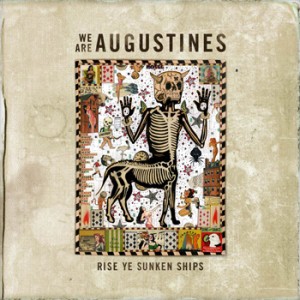
We Are Augustines - Rise Ye Sunken Ships (Oxcart)


All the brawn of We Are Augustines’ instrumentation could easily mask the emotional clout that Rise Ye Sunken Ships contains. The opening gambit of a four-to-the-floor drum beat and the ensuing anthemic guitar chord progression in ‘Chapel Song’ immediately defines the band as the brazened, Springsteen-savvy rock band that the Brooklyn three-piece are.

What the band has successfully achieved on their debut, however, is to make the thunderous drums and big, festival conquering riffs act as pillars, not obstructions, for McCarthy’s impassioned and spirited outpourings.

McCarthy has had two family tragedies darken his life so far. His mother died when he was 19 and, in 2009, his brother committed suicide in hospital whilst bring treated for schizophrenia.

It would have been a real shame if McCarthy’s lyrics – refreshing in their naturalness but heavy in sentiment (note: not sentimentality) – had been drowned out. Instead, the contrast forces a beguiling contradiction to appear between Augustines’ brassy, bold instrumentation and McCarthy’s vulnerable vocals and deeply autobiographical lyrics.

It takes a heart of stone to not feel the harsh resonance behind lines such as “Keep your head up kid, I know you can swim, but ya gotta move your legs”, on ‘Augustine’, or the dismal way Billy cries “James” on ‘Patton State Hospital’.

Meanwhile, ‘Book Of James’, the song most will be familiar with after the modest airplay it received, is a tune that cannily evokes the heart of Americana. Hats off to a record that so adeptly transported people from listening to the radio, peeling potatoes in their kitchen, to speeding down a dusty Route 66 with dry lips and the sun in their eyes.

Nevertheless, the album’s unabashed fist-in-the-air rock sound will be a turn off for many. And there is a one-dimensionality to the band’s well-worn template that all the song writing power in McCarthy’s fists can’t shift. That’s not to say there aren’t moments of surprise – ‘Strange Days’ has an undeniable pop sensibility about it, so much so that it echoes The Kinks.

And, all in all, why wouldn’t McCarthy and his band prefer to face tragedy with the help of some almighty sun-scorched rock ‘n’ roll, rather than wallow in amongst some more fashionable lo-fi style instrumentation?

Rise Ye Sunken Ships won’t win any awards for pioneering a new sound anytime soon, but a more open, honest and spirited record you’re unlikely to hear in 2012.

Published on For Folk's Sake, 7 March 2012. 

Shearwater - Animal Joy (Sub Pop)


Named after a seabird, releasing an EP called The Snow Leopardalongside albums called Rook, Palo Santo and now Animal Joy, it’s safe to say Shearwater have always had nature at their core. Lead singer Jonathan Meiburg has long used it in his lyrics to serve as a parallel to his emotions, while Shearwater’s instrumentation, like the weather, is often calm, but poised to turn into a destructive force at any time. And on this, their eighth album, it’s as if all the previous emotion of the reclusive Texan three-piece’s albums has been amassed and then unleashed. This is first noticeable on the mighty and apocalyptic ‘Breaking The Yearlings’, a song which any self-respecting Mayan follower needs on their End Times Playlist 2012. “The river is blocked, the road is hot, the sky is blazing,” Meiburgh blasts, “black smoke on the rise, the weather rolls until it’s on you and suddenly breaks.” It’s rare for a song to sound so much like the atmosphere its lyrics describe.


Brooding and dark, but concise and tightly played, the songs have a more direct urgency than some fans will be used to. There’s brevity too, with a real economical use of melodies and hooks which ensures that, despite the territory, it never becomes a listen you get bogged down in. Instead, space is allowed for a song as spirited as ‘You As You Were’, with its hyperactive xylophone, to burst out, sounding like Sigur Rós on amphetamines. ‘Insolence’, however, is the album’s centrepiece, a gothic ballad that, by its climax, has all dials turned to ‘epic’ as Meiburg, in a juxtaposition of introversion and extroversion, cries “all your life inside a chrysalis writhing?.. One more time, it’s real.” Then, as the album changes gear again, ‘Immaculate’ injects a satisfying shot of breezy punk-rock into the rural-prog palate that’s gone before, proving that Meiburg doesn’t spend all of his time pouring over wildlife annuals. Or, at least, that while he does, he’s listening to Spoon records.


Meiburg has a vocal technique that is very much a ‘technique’. It’s developed over the years and is now a curious mix of falsetto and bravado, heavy with thought and conviction throughout. Coupled with the feisty but restrained instrumentation, the album maintains a dramatic sense of wilderness that is hard to ignore. A certain Hail To The Thief-era Radiohead aggression creeps into their songwriting at points too, and ‘Pushing The River’ is a case in point. Had there been a little more dynamism of sound on Animal Joy, it would be tempting to hypothesise that, should Thom Yorke have come to embrace ornithology rather than technology with Radiohead in recent years, the Oxford band’s latest album may not have sounded too dissimilar to these eleven songs.
7.50/10
words: 

Wednesday, 15 February 2012

Band Of Skulls - Sweet Sour (Electric Blues Recordings)

If Led Zep were a bunch of Brummies who became the best rock and roll band ever, then why should the fact Band Of Skulls are from Southampton get in the way of us enjoying the ride? There’s definitely a template being followed on Sweet Sour, Band Of Skulls’ second album, and it’s one that will be very familiar to anyone who uses the ‘sign of the horns’ as a greeting method. 

Hard rocking is never off the menu on Sweet Sour’s first half, even when it looks like we’ve ordered a nice, mellow, acoustic love song- as the middle of ‘Lay My Head Down’ proves. 

Band Of Skulls have supported both BRMC and The Black Keys recently and it’s obvious the unisex trio would be a top notch support act – all cheap thrills and direct, impressive musicianship. It’ll be interesting to see which of the two Black band’s career paths Skulls will end up going down - the former appear down and out, while the latter seem to be miraculously giving rock music CPR. 

On this evidence, it’s hard to say. However, as the pensive, affecting ‘Navigate’, ‘Homecoming’ and ‘Close To Nowhere’ from the album’s second half show, there’s at least one more string to the band’s bow than would first appear.

The Big Pink - Future This (4AD)

Most of the bad things said about The Big Pink are said in reference to their breakthrough hit ‘Dominos’, an infuriatingly catchy song which we now know was written in cahoots with a well known pizza chain in order to subliminally brainwash the minds of students. But, no matter what you say about the London duo, at least they have a ‘sound’ that they can call their own. 

This ‘sound’ is one founded on a bombastic chorus, faux-futuristic guitars and a big, thumping beat. In shampooing terms, it is washed, rinsed and repeated on their second album Future This. 

Opener ‘Stay Gold’ satisfies as a more tolerable version of the aforementioned ‘Dominos’, while ‘Rubbernecking’ exemplifies their characteristic use of a juvenile vocal propelled by a heavily processed drum effect. Let it be known that, for better or worse, subtle is not a word that exists in The Big Pink dictionary. 

On ‘Give It Up’ there’s some evidence of the hip-hop direction that lead-singer Milo Cordell alluded to in interviews, but the influence is most obviously borne out in the extra beef put behind the album’s notable production. Indeed, the gargantuan effects on ‘1313’, a heartfelt ballad about waking up and then going back to bed, are certainly a treat for the ears, should they be listened to on good enough speakers or earphones. 

As on the latter song and album closer ‘77’, the band appear more palatable when they inject an earnest lyric or two into the mix, to counteract the sheer clout of their techno rock orgy. (Yet, it has to be said, The Big Pink are no wordsmiths). 

Essentially, Future This won’t disappoint those who enjoyed The Big Pink’s debut. It will, however, also vindicate those who never claimed to like them in the first place.

Wednesday, 8 February 2012

Leonard Cohen - Old Ideas (Columbia)


Back in 1988, Leonard Cohen, whilst promoting his album I’m Your Man, said he’d just read in a newspaper that as you get older, “the brain cells connected with anxiety begin to die, and you start feeling a lot better”. 24 years later, Cohen repeated the same neurological titbit in an interview with the Observer, crediting his overall better mood to this process of ageing.


But Cohen, not unfairly caricatured as rock’s Don of Despair, is a man for whom sounding downbeat has long been a way of life. Resolutely philosophical, Cohen has specialised in ruminations on the relative merits of death and birth, religion and spirituality, hatred and horniness since he first put pen to paper back in 1956.


It would be something of a shock then if ‘Laughing Lenny’, the ironic nickname given to Cohen by journalists in reference to his less than chirpy demeanour, suddenly made an appearance on Old Ideas.  


Thankfully, any fears that Cohen has lightened up as he has matured are quashed by the self-referential lyrics in the powerful opener ‘Going Home’. “I’d love to speak with Leonard”, Cohen tells us, “he’s a sportsman and a shepherd, he’s a lazy bastard living in a suit… He will speak these words of wisdom like a sage, a man of vision, though he knows he’s really nothing but the brief elaboration of a tune”.


Old Ideas is defined by Cohen’s growing sense of his own mortality, and listening to the characteristically confessional and intensely stirring songs together is hugely engrossing. The grizzled 77 year old, one of the few songwriters journalists can call a poet without it sounding conceited, is as brilliantly lugubrious and self-deprecating as ever throughout.


‘Darkness’ is a particular highlight, during which he growls, “I’ve got no future, I know my days are few”. Few expected Cohen to write another classic to join the likes of ‘Suzanne’ or ‘Chelsea Hotel #2’ after so long out of the game- but this timeless song rises very near to the top of his canon.  


Cohen’s unfeasibly deep voice charges every song with an indomitable sense of importance. He makes today’s most eminent baritone vocalists, such as Nick Cave or Matt Berninger from The National, sound fit only to serve as backing singers for Alvin & The Chipmunks. When Cohen sings, “I’m naked and I’m filthy, there is sweat upon my brow” on ‘Anyhow’, the seismic rumblings are of such a force that they risk dangerously interfering with any Richter scale that may be nearby.


But as the overtly hymnal ‘Come Healing’, and laborious ‘Lullaby’ testify, not every song on the album is vintage Cohen. However, occasional overbearing female vocals aside, each song’s modest production ensures nothing sounds pompous or dated, which is where some of Cohen’s latter day synth-infused albums have come a cropper. Instead, a classy, jazz-inflected style defines the understated instrumentation, purpose built for Cohen’s sonorous waltzes.


‘Crazy To Love You’, simply an acoustic guitar straddled by Cohen’s bottomless voice, is very much early-era Len, and will no doubt transport many diehards back to the bedsit in which they first heard the so called ‘Master of Erotic Despair’. Then, closing the album, ‘Different Sides’ is typical Cohen, playing his own relationship counsellor in a confrontation with a sultry female vocal.


Over the course of the album it becomes clear that Cohen is much too wise to even attempt reinventing himself for any new generation(s). He simply doesn’t need to, and so Old Ideas sees him playing entirely to his strengths.


9.00/10

Sunday, 11 December 2011

St Vincent - Leeds


Written for Kicking Against The Pricks.

Brudenell Social Club, Leeds. November, 16th.
On more than one occasion this evening, Annie Clark (St. Vincent) manifests on stage as a bona fide Rock God. During countless almighty guitar solos that combine with the Brudenell’s apocalyptic stage lighting and dry ice, she evokes a time when all guitarists of her ilk had mullets and wore spandex. Famously, they would use their guitars as extensions of their penis. Here and now, however, Clark’s guitar merely serves as an extension of her brilliance.

The wide-eyed, Texan multi-instrumentalist single handedly blows to pieces all the pomp, cliché and chauvinism that have justifiably given that kind of posturing a bad name. What’s left is a performance as sincerely affecting as it is entertaining; songs with an intense emotional core that sound as satisfying sonically as the most OTT rock.

Set opener ‘Surgeon’ grows, with lyrics that recall bedbound recovery from panic attacks, to a climactic nervous breakdown of cataclysmic, fuzzy synths, scrambled guitar notes and pounding drums - typical of Clark’s ability to combine sensitivity with bombast.

Clark’s innovative guitar skills alone are worth the ticket. Hers is a unique style made possible by an ability to arch her fingers into spiders’ legs, which delicately crawl up and down the fret board to produce eccentric and singular riffs. It’s abrasive, but thrillingly so, as anyone who’s heard Strange Mercy, the band’s third and best album, would testify. Cuts from the incredible album form the bulk of the set, with every song but ‘Hysterical Strength’ getting an airing.

The awesome thump of ‘Cheerleader’, fleshed out by sample pads, and heightened drama of ‘Strange Mercy’, which uses Clark’s virtuous vocals as its axis, are the pinnacles of a set that will go down as one of the best the Brudenell has ever seen. The other members of the band deserve special praise too, as it’s their proficiency that ensures that the crystalline production of Strange Mercy is preserved in a live setting.

In terms of older songs, ‘Save Me From What I Want’, ‘Actor Out Of Work’ and ‘Marrow’ - all highlights from 2009’s Actor - benefit from the muscular songwriting prowess perfected on the band’s latest record. Old set against new, it’s clear that the band were merely warming up before the triumph that is Strange Mercy.

Later on, a rampant cover of The Pop Group’s ‘She Is Beyond Good And Evil’ gives a good indication of where the inspiration for Clarke’s convoluted pop songs comes from. This is mirrored in the demented aggression of ‘Northern Lights’, which also benefits from the expert use of a theremin as drinks table and high-pitched squeal machine. ‘Year Of The Tiger’ may have other, less obscure influences, but is just as idiosyncratic- if only for its repeated refrain of “Oh America, can I owe you one?” and its irresistible prog-rock grandeur.

‘Your Lips Are Red’ brings the night to a dramatic finish as Clark, intermittingly basking in bright neon light and pulling off another thorny solo, balances on the edge of the stage before wading straight into the middle of the audience for the song’s frantic conclusion. Clark may be a Saint in name, but in spirit she’s much, much more.

BBC Introducing with Tom Robinson

BBC Introducing with Tom Robinson on 6 music My pieces for the BBC Introducing with Tom Robinson blog

Connan Mockasin

Written for Kicking Against The Pricks.


You wouldn’t expect one of the year’s most exciting, forward-thinking and rewarding albums to have been made because the artist’s mum told them to make it. But that’s how Forever Dolphin Love, the debut long-player from New Zealander Connan Hosford, aka Connan Mockasin, came to exist.


Recorded at his Mother’s request in their tall, wooden beach house in Te Awanga, the album is a sprawling yet cohesive exercise in gentle but disconcerting psychedelia, with an irresistible spirit of weirdness running all the way through it. Doing away with traditional song structures, the album feels like an extended jam between bandmates, with exceptional nuggets of pop and blues rock appearing intermittingly.


Most distinctive are Connan’s vocals, which have an appealing brittleness to them; his Kiwi accent distorted to the point of eccentricity, a creepy style accentuated by his magical, otherworldly lyrical themes. Songs about unicorns, rat-snakes and other such jibberish highlight his childlike imagination which, coupled with his obvious musical talent, gives his debut a unique voice.


Talking over the phone, Connan’s voice suggests a childlike innocence, and he seems slightly uncomfortable with the whole interview process. He avoids talking about his music in terms of genre. This, I suspect, doesn’t stem from a diva-like refusal to talk about his art (in conversation he’s actually exceedingly polite), but more from the fact that talking about his strange music in a conventional way does it an injustice - unfairly bringing it down to the boring constraints of reality.


It’s hard to think of a word that sums him up. Calling his music ‘psychedelic’ seems clichéd, conjuring unwanted images of tie-dye t-shirts and tacky hallucinogenic visuals to mind. And comparisons to jazz, in reference to the breezy looseness that his compositions float around in, don’t fit for Connan - “one of the main things I’ve read about myself in the press is that I went to jazz school, which I didn’t.”


Nevertheless, it’s a credit to Connan that he remains so difficult to categorise. When major labels started showing interest in his previous project, blues-pop outfit Connan & The Mockasins, but tried to impose their own influence on the group, Connan was having none of it.


“I was very close to giving up at that point. Having no money and nowhere to live in London and sleeping in the park… and then getting label interest, which turned out to be a lot of rubbish. They wanted us to work with specific producers and were picking the songs to go on the album, which was a crap way of doing things,” he says pointedly.


“So I got quite stressed about it all, and was like, no, I’d rather work at a fish and chip shop. So that’s when I went home and my mum told me to make my own record.”


And how about New Zealand itself, how did that shape the album? “Well, first of all, not having to worry about what the labels wanted meant that making the album was easy and really good fun.”


“And being from a very relaxed little beach village really influenced it too. But I don’t play my music when I’m in New Zealand as such, because they don’t appreciate stuff there until it’s been proven overseas, unless it’s bad dub/reggae. They’re pretty narrow-minded over there.”


Releasing his music on Erol Alkan’s eclectic Phantasy label and returning to live in London, 2011 has also seen Connan tour Europe as well as complete various high-profile support slots. On stage, Connan again is a bit of a man-boy, shy but playful and revelling in the audience’s attention.


When I saw him as a support act for Warpaint, he giddily came on and off stage after his set time was up to play more songs, attracting pockets of dischord from some people in the audience who were perplexed as to why this Andy Warhol lookalike wouldn’t piss off. But the majority enjoyed seeing a genuinely interesting support act, one that clearly got off on the thrill of performing.


I ask him if he’s always been like that? “I’ve always loved and hated performing. I don’t always enjoy it, and sometimes when you’re not in the mood and it doesn’t go well, you just want to be in bed on your own. But that’s part of it - most of the time I really enjoy it.”


Connan’s overall aesthetic is pretty distinct too, as anyone who’s seen a few of his music videos, full of anthropomorphic dolphins and face-painted, cardboard-box-headed figures, would confirm. Is there any direct influence behind all these creations? “I don’t really get inspired by other stuff, as such. Things come to me when I’m just wandering around.” Are you a spiritual person? “I guess so. There’s definitely some weird stuff out there that we can’t explain - we don’t know everything. I’m open to lots of things.”


In an interview on BBC 6 Music last month, Connan told his interviewer, to their great shock, that he’d not heard much Syd Barrett or Pink Floyd. But he says he doesn’t feel any pressure to surround himself in the vast swaths of pop music’s heritage. “I’m really lazy at collecting music,” he states.


“Now, everyone copies each other just to sound popular, and I think that’s pretty boring. It brings the quality of the music down, and makes it less interesting. I don’t see it as me being in this strange world, I just see it as other people copying too much. They’ve lowered the game.”


Meanwhile, Connan is at the top of his. Forever Dolphin Love has seen various high-profile endorsements from the likes of Radiohead, Johnny Marr, and Guy Garvey of Elbow. Connan’s collaborated with Charlotte Gainsbourg on her next album, Stage Whisper (out 7th November on Because Music), and is set to release new material with Late of the Pier frontman Sam Eastgate next year.


How about his future as a solo artist? “I think the next [Connan Mockasin] record is going to be a lot better than the last one. It’s going to be quite a lot different. I’m just playing round with stuff to try to keep things interesting.”

Album | Real Estate – Days

3 November 2011
By Nico Franks for For Folk's Sake

The word ‘sunny’ rarely gets a look in around this time of the year, when daylight itself becomes a precious commodity. But Real Estate are a band that can’t avoid the word. Categorised as ‘surf-pop’, which essentially means they sound a bit like The Beach Boys, the New Jersey five piece have been intrinsically linked with summer since their debut Real Estate was released in 2009. And album number two, Days, doesn’t show any dramatic change in sound – instead showing more of a refinement. It’s very much the album expected of Real Estate- undemanding, romantic and, of course, summery.


Given that we’re now told to buy our vegetables seasonally, should we follow the same logic with our album purchases as we enter the winter months? A few of the lyrics to ‘Easy’, the breezy, reflective album opener, could indeed jar with your average winter commuter: “Floating on an inner tube, in the sun/Around the fields we run, with love for everyone”.


But as soon as the bouncy optimism of ‘It’s Real’ leaps out, it becomes clear that what Real Estate inspire is escapism, not seasonal jealously. Often the songs end hypnotically, with repeated bars of the same rolling basslines and woozy reverb, played at a rhythm that could relax the most agitated of commuters. Vocalist Martin Courtney, with a singing style bordering on comatose in terms of its lack of urgency, dictates the woozy tone of the album to a tee.


Yet the ease with which it’s possible to drift in and out of Days, almost as if in a perpetual daydream, could be seen as the album’s main weakness as well as its strength. The band lose focus after the halfway mark and songs instead start to ape styles bettered by their contemporaries, turning nonchalance to lethargy.


‘Wonder Years’ sounds similar to Yo La Tengo at their most sunny, but lacks the enticing threat of experimentation that won the latter cult following. And ‘Younger Than Yesterday’ carries the same classic rock sound of Springsteen and Neil Young that Kurt Vile and The War on Drugs have already nailed.


But Real Estate’s defining characteristic is their canny knack for melody, exemplified on the instrumental ‘Kinder Blumen’, spaced out single ‘Out Of Tune’ and the blissfully layered ‘Municipality’. Come the end of the winding, sedative album closing track ‘All The Same’, you’ll be ready to start daydreaming all over again.

Album | Cass McCombs – Humor Risk

18 November 2011
By Nico Franks for For Folk's Sake


Humor Risk, the second Cass McCombs album to be released this year, juxtaposes itself against April’s Wit’s End; where the first was harrowing and gloomy, this is, at times, surprisingly buoyant and hopeful. And as the album’s title suggests, Cass has stuck his neck out by adding a sense of lightness to his songs, resulting in a style that doesn’t always fit. ‘Robin Egg Blue’ has an appealing pastoral folk-rock spirit, but lacks a backbone, while the ‘The Living Word’ is drearily inoffensive.


The problem is that, though each song holds its own distinct and singular musical character, sometimes the hooks aren’t strong enough to drive a song anywhere special. The repeated riff of ‘Mystery Mail’ that signals a gear change to 70’s AOR rock is initially refreshing but soon drags, once the guitarist develops repetitive strain injury.


However, diehard doom-lovers need not fear. Despite a lack in quality control in this offering, the two albums are, to borrow Cass’s phrase, cut from different sides of the same cloth. And this being the work of a songwriter very much the heir to Elliott Smith’s misery throne, there are still plenty of moments laced with Cass’s characteristic melancholia as exemplified in one song’s refrain that “pain and love are the same thing”.


His attempts at comic relief won’t have you stifling the giggles, but there’s a definite smirk lying beneath some lyrics that exposes Cass’s gratifyingly dry wit. ‘To Every Man His Chimera’, which sustains a satisfying, linear morbidity throughout, much like Lennon’s ‘Mother’, sees Cass rile against his friends and his hometown: “California makes me sick / Like trying with a rattlesnake your teeth to pick”.


At it’s best, the album’s tone is musically more aggressive than the mid-tempo fare on Wit’s End. The muffled bassline on ‘Love Thine Enemy’ embellishes the distinctly vitriolic tone of Cass’s lyrics, as he puts the knife into insincere poseurs. Elsewhere, there’s a rolling, infectious optimism to ‘The Same Thing’.


‘Meet Me At The Mannequin Gallery’ is charmingly eccentric and the lo-fi hiss of ‘Mariah’ gradually grows into something beautiful, providing an ominous, disorientating end to the album. But by that point the album’s more lightweight moments have already instilled a nagging sense that, despite its admirable diversity in sound and mood, Humor Risk is nonetheless frustratingly inconsistent.

Followers